Camo Hunt: Sniper Spy
- 4.5
- Rating
- 5.00M
- Installs
- Free
- Price

 Analysis by App-foxy
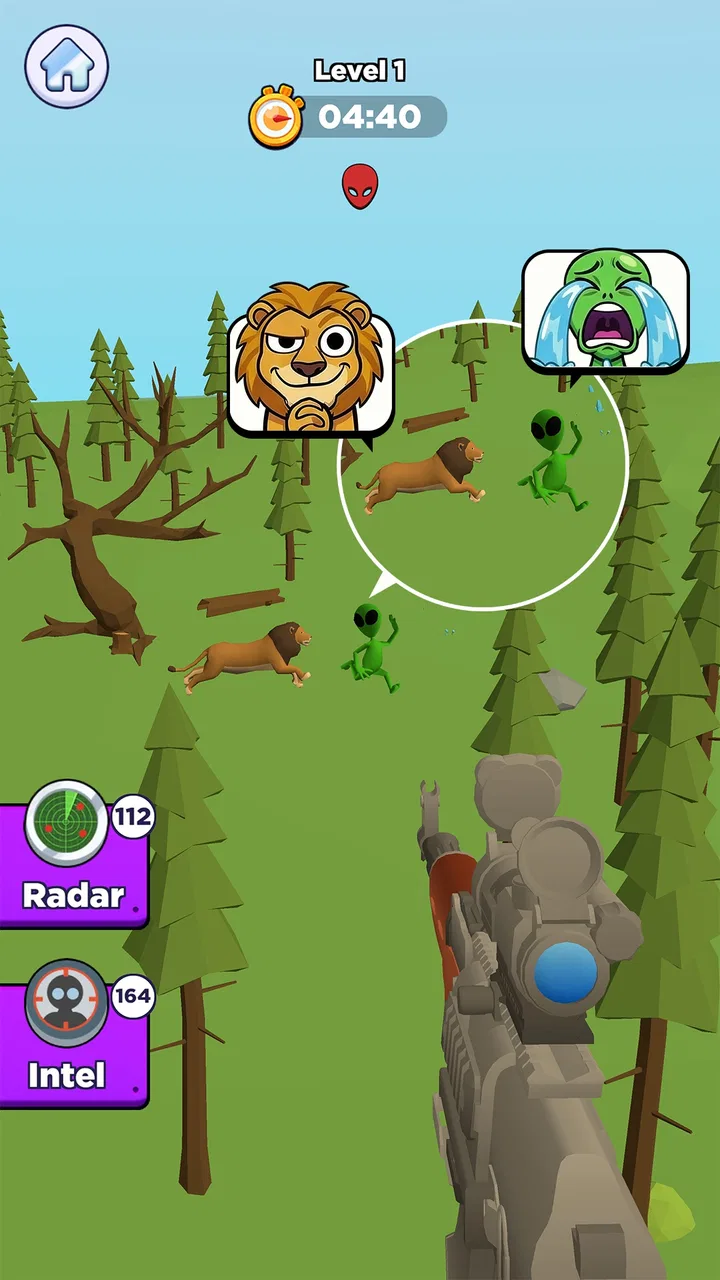
I spent time with Camo Hunt: Sniper Spy as a quick, casual shooting game rather than treating it like a full-scale tactical simulator. Its central idea is easy to understand: identify camouflaged targets, line up a shot, and clear the scene with patience instead of rushing. That simplicity is the reason it is immediately approachable, but it also creates the main question I kept returning to: does the hunt stay interesting after the first burst of novelty?
My early impression was positive. The game is free to start, belongs to the casual category, and comes from TVC Global., Ltd. It is aimed at Teen players, runs on Android 9 or later, and has built a sizable audience, with more than a million installs and a 4.6 average from roughly twenty-four thousand ratings. Those figures suggest that the basic loop connects with a lot of people, but they do not answer whether it deserves a permanent place on your phone. That depends on how much you enjoy visual searching, brief attempts, and the satisfaction of spotting something that initially blends into its surroundings.
Why the first week feels so inviting
The strongest part of the experience is the first contact with each scene. I like games that explain themselves through play, and this one does not need a long tutorial or a complicated control scheme to make its purpose clear. You look, interpret the environment, and decide when the target is sufficiently visible to take the shot. That creates a small but pleasant tension: firing too quickly can feel careless, while waiting for a clearer read makes the successful hit more satisfying.
You May Also Like

 Google Keep - Notes and lists
Google Keep’s Quiet Growth Shows the Appeal of Simpler Notes
As mobile work gets busier, Google Keep keeps winning a simple contest: capture a thought quickly, find it later, and get on with the day.

 Blood Strike: 2.5 Anniversary
Blood Strike’s Loadouts Turn Every Drop Into a Tactical Gamble
A close look at Blood Strike’s custom loadouts: how fast access to signature weapons reshapes its battle royale rhythm, rewards preparation, and narrows the gap between fights.

 Pandora - Music & Podcasts
Pandora’s Music Is Easy to Start, but Harder to Recover
Pandora’s strength is its low-effort path from a seed to a station. Its weak spot is how much confidence it asks you to place in connection, setup, and quiet recovery.

 8 Ball Pool
 Is Built on Rivalries, Rematches, and Routine
A close look at the rivalries, rematches, shared routines, and unanswered safety questions that turn a quick pool match into a persistent mobile community.

 Samsung Music
’s Quiet Strength Is Playing What You Already Own
Its reach comes less from spectacle than from dependable access to a personal library. That simplicity is both the app’s strongest retention engine and its ceiling.

 AccuWeather: Weather Radar
AccuWeather Review: A Quick, Clear Forecast for Everyday Decisions
For everyday plans, the best forecast is the one you can understand quickly. AccuWeather makes rain timing, radar, and local conditions easy to act on, with a few trade-offs.
More From Our News Desk



It works particularly well in short breaks. I could imagine opening it while waiting for a kettle to boil, sitting on public transport, or taking a few minutes away from a more demanding game. A round does not require the same mental commitment as a story-driven adventure or a competitive shooter. The game’s appeal is closer to a visual puzzle with a shooting payoff than to a conventional action game, so it suits players who want concentration without a large learning curve.
The camouflage theme also gives the opening sessions a useful sense of purpose. I was not simply tapping objects at random; I was scanning for shapes, color breaks, and details that looked slightly out of place. That habit is important because the game becomes less enjoyable if approached as a speed test alone. My best sessions came when I slowed down, checked the whole scene, and treated the target as part of a visual pattern rather than an obvious enemy waiting in the center.
That is one of the first non-obvious tips I would give a new player: do not begin by searching for a complete figure. Look for a contradiction in the image. A small edge, an unusual outline, or a detail that does not match the surrounding texture can be more useful than trying to recognize a person immediately. This approach makes the game feel more like observation than guessing, and it reduces the frustration that comes from firing at the first suspicious patch.
The first week is also when the free entry matters most. I can try the core experience without committing money, which makes it easy to decide whether the visual hunting style suits me. The game offers in-app purchases ranging from ninety-nine cents to forty-nine dollars and ninety-nine cents per item, so I would recommend treating the free start as a test rather than assuming every optional purchase will improve the experience. For a casual title built around repetition, spending is most sensible only after you know that the basic search-and-shot rhythm remains enjoyable.
Who gets the most from the opening sessions
I think this is a good match for players who enjoy hidden-object activities but want a more active finish than simply tapping a discovered item. It may also appeal to people who find traditional sniper games too intense, because the focus is on finding concealed targets rather than managing a realistic battlefield. Someone who likes careful visual work, compact challenges, and a clear success moment will probably understand the attraction quickly.
It is less suitable for anyone expecting deep weapon customization, a substantial campaign, or the strategic decisions found in a larger shooter. The store summary presents a straightforward hunting fantasy, and that is exactly how I would frame it: a focused casual game built around spotting camo targets. If you need a rich narrative, social competition, or a broad arsenal to keep you engaged, the first-week charm may not be enough.
The Teen content rating is worth keeping in mind for families deciding whether it fits a shared device. I would not describe it as a harmless preschool-style activity simply because the controls are easy. Parents should consider the rating and the presence of optional purchases before handing it to a younger player, especially if the device allows purchases without a separate approval step.
What remains after the novelty wears off
After the initial excitement, the game’s value depends on whether searching for concealed targets continues to feel like a skill rather than a routine. In my experience, the core loop has a natural advantage: every scene asks me to pay attention. That is different from an idle game, where progress can become almost automatic, and different from a fast shooter, where reflexes dominate. The recurring value comes from the small mental reset of examining an image carefully.
Still, the same strength can become a limitation. Once I understand the visual language of the game, the basic action is no longer surprising. The question becomes whether the scenes offer enough variation in difficulty and composition to make another session feel worthwhile. I would not keep it installed because I expect a major new adventure every time I open it. I would keep it for the occasional focused break, provided I am still enjoying the act of looking rather than merely chasing completion.
That distinction matters for month-to-month use. This is not the kind of app I would schedule into a daily routine automatically. It is better as a flexible pocket activity: open it when I want a few minutes of visual concentration, stop when the search begins to feel mechanical, and return later with fresh eyes. Trying to force a long session can work against the design because the pleasure comes from noticing, not from enduring.
A practical way to extend its life is to change the goal of each session. On one visit, I might focus on accuracy and avoid impulsive shots. On another, I might see how quickly I can recognize the important visual clue without sacrificing control. I would not treat this as an official mode or a guaranteed scoring system; it is simply a way to keep my own attention engaged when the basic objective starts feeling familiar. The game benefits from that self-imposed variety because its premise is intentionally narrow.
Another useful habit is to stop after a frustrating miss instead of immediately repeating the same search with less patience. In a camouflage game, irritation makes the environment look flatter, and that makes the next attempt worse. Taking a short break can be more effective than staring harder. I found that returning with a calmer eye helped me distinguish genuine clues from random visual noise.
How it compares with other casual choices
Compared with a conventional hidden-object game, this one adds a sharper sense of consequence through the sniper framing. Finding the target is not the entire interaction; the discovery leads directly to a shot. That gives the search a more decisive ending, which I found satisfying when I had spent time isolating the correct detail.
Compared with an arcade shooter, however, it is much slower and more deliberate. Players who want constant movement, rapid reactions, or explosive action may find it restrained. Compared with a puzzle game, it offers less room for multi-step reasoning because the main challenge is visual recognition. Its position between those categories is both its identity and its trade-off: it is more active than a passive search game, but less mechanically varied than a full shooter.
That makes the choice fairly clear. Choose this if you want a low-pressure target-finding game that rewards patience. Choose a traditional action game if you need evolving combat systems or fast reflex challenges. Choose a deeper puzzle title if you want logic chains, inventory use, or problems that build on one another. I would not replace those alternatives with this game; I would use it for a different mood.
The maintenance burden of keeping it installed
For me, maintenance is not only about storage or updates. It is also about whether an app earns a place in my attention. The current version is 2.0.1, and the minimum Android requirement is version 9, which keeps the technical entry point reasonably broad for compatible devices. More important than those details, though, is whether I can return after a few days and immediately understand what I am doing. This game passes that test because its premise is direct and its controls do not demand relearning.
The low-friction design is useful when I want something I can pick up without remembering a complicated build, mission chain, or control layout. I do not need to prepare for a session. I can open it, scan a scene, and decide quickly whether I am in the mood to continue. That makes it easier to retain than a larger game that requires regular practice just to avoid feeling lost.
There is a downside to that simplicity. Since the main interaction is so easy to remember, the game needs continued personal interest more than it needs a complex onboarding system. If I stop enjoying visual searches, there is not much else here to pull me back. The app does not become a different kind of game simply because I have owned it longer.
The purchase structure is another part of the maintenance question. Because the game is free, I can leave it installed without an upfront cost, but optional purchases can affect how I judge repeated play. I would be cautious about buying anything during the first enthusiastic sessions. A better approach is to play long enough to learn whether I return naturally. If I only open it when I am bored and close it after one attempt, spending will not solve the underlying lack of interest.
I also recommend checking purchase controls on a shared phone or tablet. The presence of items from ninety-nine cents up to forty-nine dollars and ninety-nine cents means the financial decision should be deliberate, particularly for younger players covered by the Teen rating. The game is perfectly reasonable as a free trial of the concept, but I would not confuse optional spending with long-term depth.
Where fatigue begins to appear
The main source of fatigue is repetition in the central action. Searching for camouflage is satisfying when the target feels cleverly integrated into the scene. It becomes tiring when I feel I am performing the same scan without a fresh reason to care. That does not make the game poor; it means the experience has a clear ceiling. The better I understand the loop, the more important scene variety and my own willingness to play in short bursts become.
Another point of friction is the balance between patience and uncertainty. If I cannot tell whether I have missed a tiny detail or simply misunderstood the scene, the challenge can shift from satisfying observation to trial and error. I found it helpful to divide the image into sections and inspect each area systematically rather than sweep my eyes across the whole screen repeatedly. That workflow is slower at first, but it gives the search structure and makes mistakes easier to diagnose.
I would also avoid playing when I am already visually tired. This is not a game I use to relax my eyes after a long day of reading or working at a screen. Its calm pace may feel gentle, but the task still demands sustained visual attention. In that situation, a simple audio game or a less observation-heavy casual title would be a better choice.
The game may also lose appeal for players who want a strong sense of personal expression. The satisfaction here comes from solving the scene, not from building a character, decorating a space, or choosing a play style. If customization and long-term progression are the reasons you usually return to mobile games, the camouflage hunt may feel thin once the initial discovery has passed.
There is a useful exception, though. If you enjoy practicing attention, the repetition can become a feature rather than a flaw. I noticed that the game encouraged me to question my first impression and inspect ordinary-looking areas more carefully. That kind of visual discipline is modest, but it is a real benefit for a short casual title. I would not call it training software, yet it can make a spare few minutes feel more active than endlessly scrolling through social feeds.
My long-term verdict
I recommend Camo Hunt: Sniper Spy to anyone who wants a free, easy-to-start casual game centered on spotting concealed targets and taking a measured shot. Its best quality is the clean relationship between observation and action: I look closely, make a decision, and get a clear payoff. The game is especially effective in short sessions and for players who prefer calm concentration over frantic combat.
I would not recommend it as a universal replacement for hidden-object games, puzzle adventures, or full sniper titles. Its lasting value is narrower. The experience earns space on my phone when I accept it as a compact visual challenge that I can revisit occasionally, not as an endlessly expanding hobby. If I expect deep systems or constant novelty, fatigue arrives quickly. If I use it as a focused break and stop before the search becomes a chore, it remains pleasant.
The strongest long-term strategy is simple: play in small sessions, search methodically, and delay purchases until the free experience has proved that you genuinely return to it. That approach also answers the practical questions most new players have. It is accessible on Android devices running version 9 or later, costs nothing to begin, and is easy to understand without a large time investment. The Teen rating and optional purchases make it worth supervising on a family device, while the narrow visual-search loop makes it a questionable fit for players seeking action or extensive progression.
With more than a million installs and a 4.6 average from around twenty-four thousand ratings, the game clearly has broad appeal. My own view is more specific: it is a well-targeted casual diversion whose quality depends on respecting its limits. I would keep it for those moments when I want to slow down, inspect a scene, and enjoy the small satisfaction of finding what was hiding in plain sight. I would remove it if I started opening it from habit rather than interest. Its lasting strength is not endless content, but the reliable focus it can provide in a short, well-timed session.
FAQs for Camo Hunt: Sniper Spy
01What is the primary objective of Camo Hunt: Sniper Spy?
Camo Hunt: Sniper Spy is a stealth-based shooting game where players take on the role of a skilled sniper. The primary objective is to eliminate targets while remaining undetected. Players must strategically use camouflage and the environment to stay hidden from enemies. The game combines elements of strategy, precision, and stealth to create an immersive experience.
02Are there any in-app purchases in Camo Hunt: Sniper Spy?
Yes, Camo Hunt: Sniper Spy offers in-app purchases. Players can buy various upgrades, such as advanced weapons, enhanced camouflage gear, and additional mission packs. While the game is free to download, purchasing these items can enhance gameplay and provide a more customized experience. However, all levels can be completed without additional purchases.
03What are the system requirements for Camo Hunt: Sniper Spy?
Camo Hunt: Sniper Spy is designed for both Android and iOS devices. For Android, it requires version 5.0 or higher, while iOS users need iOS 10.0 or later. The game is optimized for a wide range of devices, but for the best experience, a device with at least 2GB of RAM is recommended. Make sure you have enough storage space available for installation.
04Does Camo Hunt: Sniper Spy offer multiplayer options?
Currently, Camo Hunt: Sniper Spy does not offer a multiplayer mode. The game is focused on a single-player experience where users can immerse themselves in various missions. However, the developers have hinted at potential updates that might introduce competitive or cooperative multiplayer options in the future, enhancing the game's replayability.
05How does the game ensure fair play and prevent cheating?
Camo Hunt: Sniper Spy employs a robust anti-cheat system to maintain a fair playing environment. The game servers use advanced algorithms to detect irregularities in gameplay, ensuring that all players adhere to the rules. Regular updates are released to patch vulnerabilities and improve security, thus providing a balanced and fair experience for everyone.
Pros
- Engaging and immersive gameplay.
- High-quality graphics and sound.
- Wide variety of challenging levels.
- User-friendly interface and controls.
- Regular updates with new content.
Cons
- Requires a stable internet connection.
- In-app purchases can be pricey.
- Can drain battery quickly.
- Occasional in-game ads.
- Limited offline play options.

Camo Hunt: Sniper Spy
Gallery